
The Adder
Fiction

Sky the colour of bluebells peaking through clouds white at the peak of the dome, descending to charcoal grey at the horizon, but there is no horizon in this horrific city, just the tops of apartment blocks and shotgun terraces as I ramble the streets this afternoon, June 1st, 2020. I must see my father who is dying of sarcoma in hospital, but they won’t let me. See him, not speak to him. Specifically, I must see his upper left thigh with his leg drawn up.
“Not for any reason, no, I’m very sorry. We can pass on any message you like,” says nurse Julia, my sparring partner. A great plague has descended, a plague of people who thirst for drama and importance. The satisfaction with which she denies me my birthright, to see a dying father!
Hirst, in Shipwrecks of the Gippsland Coast (1975), makes no mention of the Adder. Neither does Brereton in his Bass Strait Maritime Disasters (1996). O’Rourke gives one paragraph about the gold being diverted from the overland route due to fear of the Kelly gang, in his Victorian Goldfields (1929), and notes the haste in which the Adder’s voyage was arranged, writing, “rushed to Melbourne via stagecoach in the dead of night, the shipment was stowed on practically the first ship that could be found, the Adder, out of Boston, under the command of a Captain Lindsay.”
After calling in at Anderson’s Inlet for extra coal the Adder, laden with Deborah gold, was last seen off Cape Liptrap by the relief lighthouse keeper, never arriving at Sydney (O’Rourke). The potted histories online don’t add much more, just local rumour, reductions of reductions of hearsay and legend. There was a rumour this Captain Lindsay commandeered the ship and went to Maoriland or South America but I know that’s not true.
Nothing can just disappear in this day and age, you will say. Well, it didn’t disappear because my father found it. A diagram of its location appears on the skin of his leg when he tucks it up under himself. The wrinkles and moles in his skin form a map of the coastline and the knob of his fibula was the spot. It was Australia Day and we were at the beach, as was our custom. My father had just dug up a children’s toy tractor he had found with his metal detector and was about to get up off the sand when he laughed and, pointing to his thigh, asked if I knew what it was.
“Your thigh?”
“Wrong.”
I can see it in my mind; its precise shape is like a forgotten melody whose name is on the tip of my tongue. This late evening I look out the window to the clouds to find it. Patterns of clouds, of which no one could disagree there are theoretically an infinite number, must surely take this precise shape in the sky at some point. I am sure I would recognise it if I saw it.
“This is a treasure map.” he said, indicating with his fingers.
“Ninety Mile Beach. The Adder.”
“Thou shalt tread upon the lion and adder.” was tattooed down his mighty left arm in a small and close cursive.
When I was ten years old he told me more. I could look up the exact day because it was just after Australia had qualified for the World Cup against Uruguay on penalties and he was drunk on Crown Lagers and texting his buddies about the game. He turned the volume up on the television and handed me a beer, closed his bluebell (yes, bluebell) eyes, breathed out a relentless sigh and sobered up. He could do that at will, it seemed—get drunk then sober up.
As Craig Foster intoned his rhapsodies and the KFC ads shouted, my father spoke. I had to lean in to hear him. “It’s out where these islets are that belong to Tasmania, turn east, there is a reef. No one goes there. But you can’t raise any suspicion. The government will think that gold still belongs to them but the underwriters paid out at the time. Never sell more than a little bit at a time. Learn the art of smelting and jewellery making.”
So I resized wedding rings and fixed necklace clasps out of a dowdy strip mall in South Yarra, apprenticed to a Russian jeweller named Volodomyr who smoked in the shop but was usually content to leave me there alone. It was a modest living, tolerable, enjoyable, solitary, enough to rent a second-floor apartment on my own, and all bearable because I knew the big payout would come from the ship, whether before or after my father’s death, it mattered not. There was plenty of time for reading between customers and jobs.
Once a year or so my father would bring in a doré bar wrapped in fish and chip paper. Out of this I made, whatever I wanted to make: flat mandalas, pens, gold leaf book covers, recreations of Aztec jewellery I’d seen in pictures, a Saxon breastplate. Some of these creations were gifts for my father and mother. Others I sold. Volodomyr’s shop developed a reputation for unusual items. I was even featured in a weekend magazine as an artist. Then the lockdown came, and with it the end of my business. Volodomyr urged me to take up smoking so I wouldn’t catch the virus and still left my door ajar against the law for a few diehards who didn’t care but it wasn’t enough to cover the rent and my wages, and neither could the government “assistance” and all of a sudden with my father’s diagnosis and his rapid decline, I was adrift on the tide.
A sleepless night, a Saturday. Despite the cold usually this part of the city would be humming with cars and people, a hubbub to which I’d grown accustomed, as soothing as the sound of waves for those who live on cliffs by the sea, but all I heard was the click of the crosswalk buttons, clicking for the blind, a welcome reform but a torment to my sleep. Not for an instant have I believed in this fake virus, this charade of a dying people cowering in their homes. “It is a pity that you huddle,” said Voss, and he was right.
I check my phone to see that McDonald’s opens in thirteen minutes at 4.30. Sweeping my pea-coat on I head downstairs and out into the ubiquitous night of the denuded city. For no reason at all a memory of getting rolled by a wave as a child flashes back: screaming, spitting, coughing up the salt water, tears and exhaustion lying in Mum’s arms.
Outside the hospital with my second cappuccino of the morning, getting ready to deal with these insane prison guards. The hospital has just been refurbished with bulging curves and playful colours and streaks of rainbow ribbon inlaid in the floor. A three-story tube aquarium rises in the foyer. A man in a blue gown hooked up to an IV smokes a ciggie while his masked male nurse watches on, and watches me. I call the hospice desk and it’s Julia again on the phone. Julia or Julie; maybe there are two women, maybe one, I don’t know. They sound the same at any rate.
“No, all we can do is pass on a message. If he’s religious I can let a priest in for last rites, but that’s all. We know it’s very difficult for some, but you’re not the only one in this situation.”
Oh, but Julia, I am.
“Please pass on this message, Julia. Julie, can you hear me? Write this down and yell it in his ear. ‘Julia is a fascist sow!’ Did you get that? Repeat it back so I know you understand.”
They make you feel like a murderer for wanting to see your own father in his dying hour. If he’s Catholic, my God, Julia, are you insane? My father never knelt before anything in his life and if he could walk he would bust past your Nurse Ratched station before you could waddle around and fill up the doorway to stop him.
At home I craft an outfit using a cut-out from a white book cover (The Reign of Quantity by Guenon), and a black shirt. It takes some doing to match the shirt with the images of priest’s necks online. It’s a specific type of shirt made especially for the white bit to fit into, but with needle and thread I managed to make a reasonable alteration.
The hospital is nearly deserted. Duly and ridiculously masked I pretend to sanitise my hands at the door. The receptionist in her purple tent of a blouse behind a bumblebee -patterned mask, hands me silently the clipboard with the sign-in sheet. A name? Of course, Father, but Father what? Father Foster, ridiculously, comes to mind, Father Craig Foster.
The palliative care ward icon the top floor so the dying will be closer to heaven. Walking slowly, with an air of extreme sorrow, I cast sidelong glances into the rooms, being careful to show with my feet that I am utterly certain of where I am going. My father’s room is near the end of the corridor. Out his window there’s an uplifting view of the concrete tower next door looming between the vents and fans and air shafts between the two towers. Off in the corner one can make out the top of a palm tree in one of the city’s gardens. The beeping of the machines that makes you want to off yourself. It’s not so bad in the palliative ward because they’ve already given up so it’s quieter. On his hand they’ve placed a ludicrous rubber glove filled with water.
“Dad,” I whisper, “Dad.”
He is out cold, no response. Pulling his blankets down, I maneuver his leg into position and snap a photo. Just as everything is back in place a voice. Not Julia but someone like her, or maybe it is her.
“Sir, no touching the patients.”
“I have to touch them, it’s part of the ritual.”
“I’m sorry, that’s against the rules.”
Sir? You mean Father? Julia, you ignoramus.
Yes, I spent some last minutes with my father but they are not for you to know about. More man than I am, the last true fisherman in Victoria. Have you gobbled down sushi on the go in your big city job? Have you eaten crab legs on a Southbank terrace restaurant or calamari in a Lygon Street mob front? What about battered gummy shark at a picnic table in a gap on the foreshore vegetation on a summer’s evening where the breeze blows the mosquitoes and flies away without chilling you? Then you owe him your thanks. A born fisherman, he could stand on the deck in a gale with a gaffe in one hand and a cigarette in the other, knew every knot in the book and a few that weren’t, could measure if a fish was legal size by sight at fifteen yards, could take a boat through the heads blindfolded; carried twelve hundred restaurants and cafes and markets around the state and into New South Wales on his shoulders. And in his spare time, a treasure hunter.
I rip off my priestly collar outside the door and turn around so purple tent can see me drop it in the bin that’s there seemingly for just such a purpose but she’s gone, the desk is deserted, like the hospital. I throw the collar through the automatic doors onto a lime green ribbon in the floor.
I’ve been up for hours but it’s only 9.30. Plenty of time. As the city recedes I breathe easier and easier. It feels like I’m in a car ad, that’s how deserted the roads are. I turn off the highway on to MacDonald’s Track to get around the police checkpoint at Lang Lang, then through the hills and along the cliffs, past the windfarms, out to the old wooden shack with the tin roof.
Turning the car off, I check my phone. A missed call from the hospital. When I call back, it’s Julia.
“Your father passed away a few minutes ago.”
Dad’s old boat, the Skipper, has seen better days but she’ll do. And he’s in my head and in my heart the whole way out. The wind and the clouds are cold and dismal and the light is fading but all the better to be alone. This is for you, Dad, this is for you. Cliches don’t fail us at times like these. I have never felt more alive, pulsing with energy and purpose. Preparing the boat, pushing off and rounding the exit of the bay I’m like a bloodhound on a scent-trail, without thought, without mind, a perfectly created animal.
Passing out of Victoria, giving my regards to Lohan as I passed his cave, the boat crossed into Tasmanian waters. East Monceur Island, littered with seals and drowned in the cacophony of mutton-birds. I have my phone out but the picture will be in my mind for all time. Bobbing on the chandelier sea, my father’s thigh visible along the shore. The fish finder picks up an unnatural line rising gently from the bottom. After anchoring, I suit up with my snorkel and weight belt and dive for the Adder. You can see why it was never found. It sunk in about five metres of water on to a ledge just before a drop off. Most of the ship must have fallen to the ocean floor, leaving the cargo on this scimitar-curved ledge. You’d need ungodly luck to find this place with a sounding.
After four dives into the darkening, heaving seawater, dense with particulate, what look like little dust motes of gold in my headlight, I finally find it, the Adder’s hold, and bring a single bar up into the new dark.
END
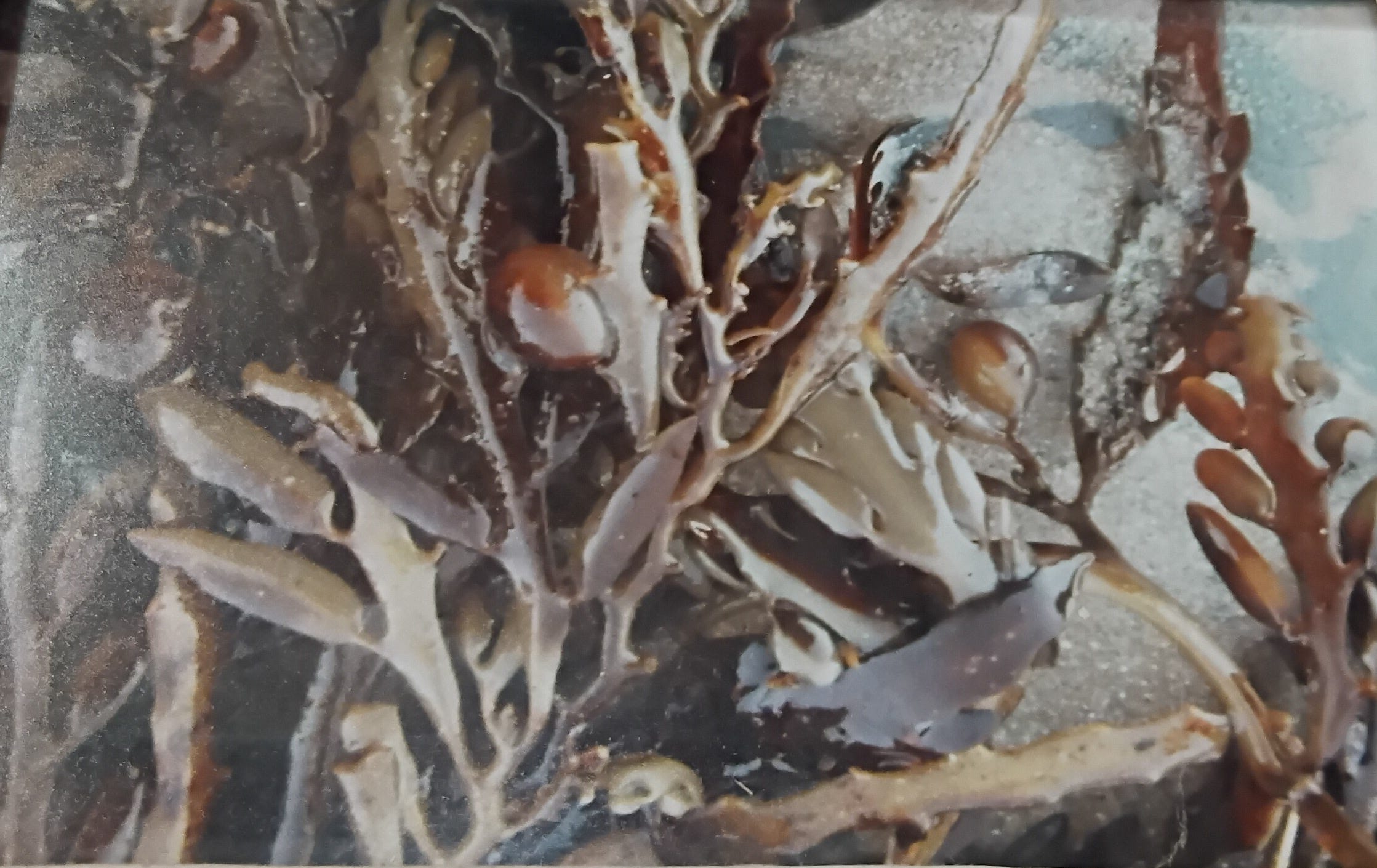
Picture: “Bass Strait Seaweed” by Anna Williams
A note about substack fiction: I consider substack to be a laboratory to test out my writing. While not a first draft, this is a “first pass” at the story.
For fully polished work, my first book, Spare Us Yet & Other Stories is available through Wiseblood Books here: https://www.wisebloodbooks.com/store/p159/Spare_Us_Yet_and_Other_Stories%2C_by_Lucas_Smith.html
Hello, I still haven't worked out this broader Substack culture (why so few comments?). Anyways, I found that enjoyable to read. It made me remember watching my dad answering phone calls about his mother spending her last days in palliative care in 2020, but dad wasn't allowed to cross the ditch to be with her (or attend her funeral, or go home for a few years after that).
closed his bluebell (yes, bluebell) eyes,